
How Lab-Grown diamonds are taking over the world.
- innoverseinfo
- Jul 19, 2025
- 2 min read

What if I told you that you can buy a 1.5 carat diamond for merely $534?
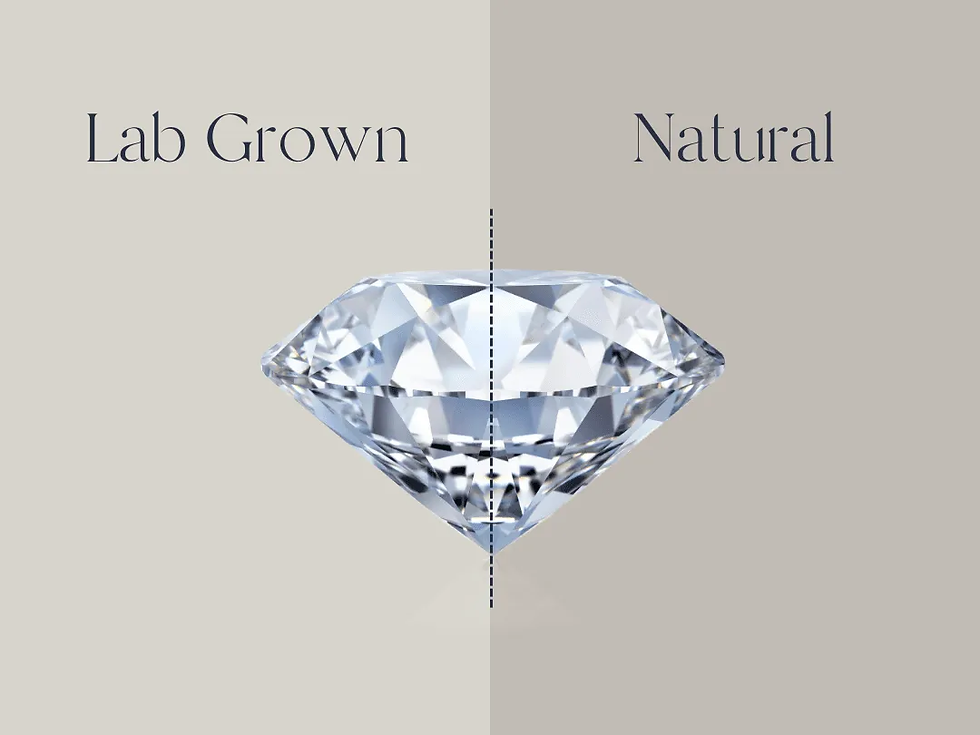
Well that isn’t completely wrong, except it would be a lab-grown diamond and not a natural one. Synthetic diamonds have been taking over the jewellery market by storm, occupying about 14.3% of the diamond market in 2023. These diamonds not only cost about 30–40% lesser but also appeal to customers looking for ethically sourced diamonds. While diamond mining adversely affects the environment, destroying forests, habitats, emitting greenhouse gases and causing water and air pollution, cultured diamonds have a significantly lower environmental impact. Statistically speaking, synthetic diamonds produce up to 5.5 times less CO₂ emissions than natural diamonds. But how does this technology work?
The origin of this process dates back to the 1950s in a GE (General Electric) laboratory in New York. Conducted within the codename “Project Superpressure,” scientists successfully manufactured the first synthetic diamond using high pressures up to 100,000 atm and high temperatures of 1600º C. In this high-pressure system, graphite was dissolved in a metal solvent, allowing carbon atoms to crystallize onto a diamond seed. This achievement was credited to scientists: Herbert Strong and Howard Tracy Hall. Simultaneously, in Sweden, another company called ASEA also became the first to grow 40 small diamond crystals. However, these diamonds were claimed to be inadequate for gem use and suitable only for industrial usage.
Consequently, this discovery made way for GE to create gem-quality crystals in 1971. This was a refinement of the HPHT method, where heat and pressure were applied to a carbon source surrounding a diamond seed, causing it to crystallize and grow. However, due to the lack of clarity and these synthetic diamonds being yellow, they did not receive high grades. Further research conducted on this discovery observed an excess of nitrogen which caused the yellow colour. Thus scientists in the US, Russia and China conducted strenuous research to create synthetic diamonds with clarity, color and size that exceeded that of natural diamonds.
As these techniques evolved, modern methods like HPHT (high pressure/high temperature) treatment were further developed to perfectly mimic the diamond forming underground process. Skip to today, a process called CVD (chemical vapor deposition) results in the formation of large, gem-quality lab-grown diamonds. This even occurs at a significantly lowered cost due to the absence of high pressure and temperature. In this method, a carbon-rich gas is heated into plasma inside a chamber, causing carbon atoms to bond with the seed and gradually grow it into a larger diamond. As previously mentioned, the cost to manufacture lab-grown diamonds has constantly been decreasing with the introduction of newer technological advancements.
In conclusion, from projects conducted in 1954 to developing synthetic diamonds showcasing a variety of colours, lab-grown diamonds have been and will be the next big thing. They cater to consumers looking for larger, cheaper, sustainable and a wider variety of alternatives to naturally mined diamonds. Top companies like “De Beers”: the world’s largest diamond mining company, have also introduced lab-grown diamonds through its line “Lightbox.”
This is just one compelling example of an accelerating innovation in the jewellery and gem market. To stay updated with more such interesting findings, stay tuned — and follow us!
Source:



Comments